Saturday, February 21, 2015

The New World

January 2, 2015

On the evening of August 3, 1492, Christopher Columbus set sail west from a small port in southwestern Spain with plans to reach the East Indies and gain entry into the spice trade. Five weeks later, instead of reaching Asia, Columbus landed in the Bahamas and the rest is history. Hoping to avoid Columbus's mistake, we had traveled east instead of west via the old Silk Road route through Constantinople (which incidentally by falling to the the Turks in 1453 had triggered a search by Europeans for an alternative, westward route to India). 

We had several advantages over Columbus. Constantinople was no longer closed to travelers heading west. We were pretty sure the world was round. And we were able to travel by this modern invention called the plane. With those advantages in hand and a little luck, we accomplished something Columbus failed to do in four tries, and landed in India around 5:30 am after only 26 hours of travel. 

I suggested we fire a lombard (a type of cannon used to alert Columbus that land was spotted on his first voyage to the New World) upon landing, but Becky didn't think it would go over well with the airport authorities. 

As we departed the plane, our first impression of India was not the sweet smell of spices but an acrid  smoke smell. As we walked out into the cavernous and modern Indira Gandhi International Airport a cloud of smog hung over everything inside the terminal. I've been to smoggy cities - Athens in 1991 and Cairo in 2011 come to mind, but I'd never seen smog inside a building before. 


Twenty-six Hours of Travel Does Nothing to Her Beauty

After making our way through immigration and collecting our luggage, we armed ourselves with a fistful of rupees - 10,000 - from an airport ATM. With the exchange rate of just over 60 Rupees to the dollar, you can quickly have a false sense of wealth by carrying around thousands of Rupees - though not quite like the million Dong I had in my wallet in Vietnam the year before.

Having read that many of the taxi drivers refuse to use the meter for foreigners, we decided to go with the pre-paid taxi booths to get to our hotel in the center of New Delhi. Walking up to the first booth, the man quoted us 400 Rupees for a taxi and then eyeballing us, changed that to 800 Rupees because he said it was 400 each. Having done a little research ahead of time on the internet (a world traveler's greatest tool), I knew this was an exorbitant price for a ride downtown. As we prepared to walk to the next booth, the man quickly lowered his price back to 400 Rupees. Welcome to India, where everything is negotiable. 

We walked out of the airport and matched our voucher to the appropriate taxi and settled in for the 20 minute ride to our hotel. As the driver reached for his seat belt, we attempted to find ours. But as with most taxis in the developing world, no seat belts were to be found for the passengers. We would just have to place our trust in our good driver.

As we rode downtown, the city was dark with a steady rain falling. A chill was in the air. Not how I had imagined India. There were few street lamps and the ones that existed threw off a weak light so you couldn't make out the buildings by the side of the road. Although it was 6 am and still dark, there was lots of activity, with people walking in the road and huddling around small fires.

We were staying at Bloomrooms@New Delhi Railway Station, near the New Delhi Train Station. Located in the Paharganj neighborhood, the area is a haven for low-budget hotels. Fresh off her role in Titanic, Kate Winslet starred in Holy Smoke!, a movie that was took place in Paharganj and depicted an Indian train that hit an elephant and then sank slowly into the morass of the chaotic neighborhood. Unfortunately, the film was not a big of a hit as Titanic, mainly because Winslet's co-star, Harvey Keitel, wasn't as dashing and handsome as Leonardo Di Caprio.

Although many travelers had reported the neighborhood to be dirty, seedy, and somewhat scary, we decided to stay here because we hoped to catch a whiff of Ms. Winslet's left over magic. That and the hotel was right next to train station at which we had to catch a 6 am train the next morning.

As we neared our hotel, our taxi driver began humming Celine Dion's My Heart Will Go On. The breaking dawn allowed us to size up our neighborhood. Although we were very close to the train station, not a lot of people were out and about. Through the rain we could see two and three story structures in various states of disrepair. Some of them were completely gutted as if someone had decided to remove all of the windows and doors to the building. However, the Bloomrooms hotel was in a sleek, modern looking building.

To our relief we were allowed to check-in to our hotel room immediately. There is nothing like arriving in foreign land early in the morning after crossing the ocean and then having to wait until late afternoon to freshen up. In fact, in his best selling memoirs, Christopher Columbus commented on how much in was looking forward to checking into his hotel room when he first arrived in what he thought was the East Indies.

Up three flights of stairs (or a extremely tight and cramped elevator ride), the door to our room faced a nice looking inner courtyard. Inside was an extremely modern and spacious room with a lightning fast wifi connection. We found the small outside balcony facing a completely gutted building to be very romantic. The most interesting feature of the room was the shower.

The shower had a floor to ceiling window that separated it from the main hotel room. You would think that the person showering would have control over whether the window shade was up or down to protect her privacy. Intriguingly, the shade was on the main hotel room side of the shower. Thus, a person could be innocently whistling to herself in the shower (perhaps something catchy like the theme song to the movie Titanic) while another person in the hotel room could suddenly yank the window up and see all. It made no sense to us Americans with our good puritanical backgrounds. 


Doing her best Kate Winslet impression


After exploring the room, we FaceTimed the kids and my parents to inform them we had one-upped Christopher Columbus. FaceTime is another marvel of modern international travel. In years past, we would have to first find a street kiosk that sold an international telephone card, then you would have to find a telephone booth that made international calls, which wasn't always as easy as it sounds. I remember once in Barcelona, Becky and I probably went to a dozen telephone booths all over the city before we found one that we could call home on. Now you just whip out your iPhone, connect to the hotel's wifi, and within seconds you can see your kids. I could even switch the iPhone's camera to the rear facing one and give the kids a tour of the room and show them our view from the balcony while FaceTiming them. Fantastic.

Showering and changing into clothing that we hadn't been wearing for 26 hours made us feel like new people. In the corridor, we discovered fresh tea to help us combat our jet lag. Tea is one of the joys of India.

Although local tribes had long drank tea in northeast India, it did not become a huge industry until the British introduced it to India in an attempt to break the Chinese monopoly on tea. And Indians did not begin drinking it en masse until the 1950s. Today, it's is everywhere - grown in the north and south and found on the streets and train stations. And a hotel room without a tea kettle would be a major scandal. Tea is so beloved on the subcontinent that Indians consume 30% of all the tea grown on the entire planet.

The tea in India is usually served with the hot milk and sugar already added. The sweet mixture was so good that we went cold turkey on our usual coffee and almost exclusively drank tea during our entire trip.

Fortified with caffeine, we decided to venture out and find some breakfast. According to our copy of The Rough Guide to India, Connaught Place is the commercial heart of New Delhi and has lots of good food options. A quick search on Google Maps showed it to be less than 2 kilometers away (about a mile for those still on the Imperial Units system). Because a light rain was still falling, we obtained a ride from the hotel's complimentary's minibus.

Delhi has probably been continuously inhabited for more than two thousand years. From the mid-16th Century to the mid-19th Century, large parts of India were ruled by the Mughals, a Muslim dynasty that claimed to be direct descendants of Genghis Khan. Our hotel was right on the edge of Old Delhi (though confusingly not the oldest part of Delhi), which was the capital of the Mughal Dynasty. By the 19th Century, the British, through the East India Company, controlled large parts of India and finally deposed of the last of Mughals in 1857.  A year later they established the British Raj - the term used for the British rule of India.

The British established their first capital in Calcutta in the eastern area of India known as Bengal. Having a strong hatred of all things associated both with the Cincinnati Bengals and Mother Teresa, King George V declared in 1911 that the capital of the Raj would be moved from Calcutta to Delhi. To carry out this move, the British built an entirely new city south of Old Delhi, known today as New Delhi. Connaught Place was developed to be the showplace of the new British capital and sits on the northern edge of New Delhi.

At the center of Connaught Place is a circular central park (the Inner Circle). Surrounding the central park are two circular rows of terraced buildings which create a the Middle Circle and the Outer Circle. Seven road radiate from the central park. The buildings house restaurants, shops, hotels, and businesses.

Our minibus driver explained that the shops around Connaught Place did not open until 11 am. Because it was only 9:30 am, we asked him to drop us near an establishment that served breakfast. Wandering out of the minibus, we noticed that there were almost no people around - which we thought odd considering we in the heart of a city of 15 million people. The restaurant our driver highly recommended was empty and obviously closed. We headed for the middle circle and began to be approached by men at regular intervals.

The script with every man was essentially the same.
"Hello, where are you from?" 
"America" 
"Ah Welcome - Obama is coming. Obama is good." [Sometimes they would ask us from what part of America we came from and after we told them near Chicago, they would tell us they had a cousin that lived there]. 
"Yes, we like Obama - it is exciting that he is coming to India in a few weeks."
 They would then tell us what street we were on and proceed to ask:
"What are you looking for?" 
"Oh - we are just walking around - enjoying New Delhi." 
"I work for the tourist board. The tourist office is close by. Let me take you there." 
"No thank you - maybe later."
The persistent ones would then proceed to tell us that the area was dangerous for pickpockets and proceed to pull out an official looking "Tourist Bureau" ID card and again urged us to come with them. One man even told us the direction we were headed in - south - was dangerous, which was preposterous considering the area south of Connaught Place contained the important government buildings such as the parliament and prime minister's palace.

Luckily, I had read our copy of The Rough Guide to India ahead of time which warned:
On Cannanught Place and along Janpath steer clear of phone "tourist information offices" (which touts may try to divert you to - a typical CP tout chat-up line is to inform you which block you are on, so be suspicious of anyone who comes up and tells you that unasked) and never do business with any travel agency that tries to disguise itself as a tourist information office.
Wikitravel.com also warned:
Many first time travellers to India find themselves falling victim to scams and touts, and unfortunately Delhi has a lot of both. Be on guard for anybody trying to help you by giving you unsolicited directions or travel advice.
Fortunately, a few polite no thank yous and "maybe later"s caused the touts to leave us alone.

Fending off the various touts, we walked around the Middle Circle trying to find an open eating establishment. Even the Indian megachain,  Cafe Coffee Day  was closed. With over 1,600 locations, the Starbucks of India was named the "most popular hangout joint amongst youth" on the Subcontinent.  Just not in the morning apparently.

Giving up on the Middle Circle, we headed to the Outer Circle of Connaught Place. We spied the Hotel Saravan Bhavan which appeared to have people eating in it. Although we didn't know it at the time, the restaurant is one of the largest vegetarian chain restaurants in the world. Founded by restauranteur, P. Rajagopalin, in Chennai [the largest city in south India], there are over 30 locations in India and another 47 world wide, including in Europe and the United States.

Rajapopalin pays his employees well and gives them fantastic benefits. The food Rajapopalin created for his restaurants is delicious southern Indian fare at very reasonable prices. Sounds like a great founder and owner? There was only one problem, Rajapopalin is also a convicted murderer.

The whole sordid tale was laid out in a 2014 profile in the New York Times Magazine. Rajapopalin was convicted of murdering the husband of a woman he wanted to marry. The tale involves astrology, multiple wives, and an attempt to tie the victim on a railroad track so a train could run over him. What better place to begin our introduction to authentic Indian food.

Our breakfast consisted of several puris, idlis, and a dosa. Puri is a deep fried Indian bread on which we placed a spicy potato mixture and sambar [a spicy lentil stew]. An idli is a small cake made from rice flour. Ours were served floating in sambar. Idlis are the staple breakfast food in southern India. And a dosa is a crepe made from rice and lentils - also a regular southern Indian breakfast food. Dosa's can be as large as a table. We ordered the Masala Dosa, masala meaning a spice mix, which came filled with spicy potatoes.

I also ordered a sweet lassi, which is a drink made of yogurt, water, and sometimes spices and fruit. Becky had a masala chai [a spiced tea drink]. The breakfast was murderously good and all for under $10 for the two of us.


Killer Puri


A Criminally Good Serving of Sambar Idli & Lassi Drink


A Masala Chai that was so Tasty, it was Almost Lethal


As we ate breakfast, we studied the map of New Delhi that our hotel had given us. The map showed the Gandhi Smriti museum to be only a short walk south of Connaught Place. Gandhi spent the last 144 days of his life and was assassinated in 1948 at the location. It was a must see for us.

We stepped back out into the street and headed south on Janpath, one of main boulevards in New Delhi. The light mist had stopped falling and many more people were out and about, though not as many as you would imagine when you think of India, a country approaching 1.3 billion people. Later in the day, we would experience that India with teeming masses near our hotel.

On our way to the Gandhi Smriti, we stopped to walk around the Jantar Mantar, a giant observatory built in 1724 by the founder of the city of Jaipur, Jai Singh II. Consisting of several huge instruments, it was used to predict the movements of the sun, moon, and planets. Apparently, the Mughal emperor at the time depended upon the location of astronomical objects to decide when to begin a journey. Though with today's incredible smog and haze in which we couldn't even spot the sun, it is hard to imagine ever being able to spot any celestial objects from Delhi.

The most spectacular of the instruments is the Samrat Yantra, a giant sundial in the shape of a triangle that points towards the North Pole. Because it showed him the way north, explorer Robert  Peary first attempted to reach the top of the world by setting out from the Jantar Mantar in 1908. He abandoned his attempt at the foothills of the Himalayas when he realized dog sleds were not the best means of transport over those mountains. He then sensibly set out from New York City on his next attempt to reach the North Pole in 1909,


Robert Peary Setting Out from the Jantar Mantar in 1908 


Heart Shaped Astronomical Instrument used to Find the Planet Venus


Samrat Yantra Points North - Explorer Peary's Dogs would Slide Down for Fun


Replica of the Colosseum used for Gladiator Fights when the Emperor was not Consulting the Stars. It's also a Favorite of Russell Crowe.


We attempted to use the giant astronomical instruments to determine our way to the Gandhi museum we were trying to find. But with the heavy smog continuing to hang over the city, we were unable even to spot the sun and had to rely upon our hotel map which showed the museum to be only two blocks south on the Janpath boulevard. After a few blocks of walking and no sign of the Gandhi Smriti in sight, it began to dawn on us that our hotel map was a crude one and probably not drawn to scale. However, there were regular signs for the Gandhi Smriti that continued to point south and so we ventured on.

We passed several high end hotel establishments with pretentious names such as The Meridian, Shangri-La Eros, and the creative The Imperial. Eventually, we crossed New Delhi's most famous boulevard, the Rajpath. A wide boulevard lined on both sides by parks and trees, it is India's Champs-Élysées, which starts at the Rashtrapati Bhavan (the President's palace) and continues for approximately one and a half miles to the giant India Gate - an arch similar to the Arc de Triomphe in Paris. The famous opening scene in the movie Gandhi, with over 300,000 extras for the great leader's funeral, took place on the Rajpath.

The view from the presidential palace to India Gate is supposed to be a spectacular one. But from where we were standing (the intersection of the Janpath with the Rajpath), we could not make out the presidential palace less than a mile away because of the heavy smog.  We could barely make out the India Gate less than a half mile away. I know I continue to go on and on about the smog, but we had never seen anything like it. It was atrocious.

Crossing the Rajpath, our journey south continued on Janpath road. On both sides of the street, buildings became less frequent as trees and fields dominated the city scape in this part of New Delhi. And then we saw monkeys - real live monkeys - dozens of them running on railings, jumping from trees, and searching through garbage for tasty leftover morsels of human food.

Delhi's relationship with the monkeys is a complicated one. Around 30,000 red-faced rhesus monkeys live in the city and can be a menace to the human population. Many of them carry diseases like rabies and tuberculosis. They can be aggressive towards people, sometimes attacking them. In 2007, the deputy mayor was killed when he fell from his balcony while fending off a monkey attack.

The monkeys also steal food and wreak havoc on buildings they enter. They even invaded a local hospital after learning how to use the automatic doors. And the monkeys particularly like to steal whiskey and get drunk. As they say, monkey see, monkey do.

They were even seen as a potential threat to President Obama when he visited in 2010 and 2015.

However, the monkeys are revered in Hindu society as an incarnation of the monkey god, Hanuman. Every Tuesday, Hindus worship the monkeys by feeding them. In addition, thousands of temples are devoted to Hanuman throughout India. Therefore, attempting to rid New Delhi of the monkey menace by using violent means is unthinkable.

Over the years, the city has attempted to manage the menace by deploying larger langur monkeys on tethers to scare the smaller rhesus monkeys off. But this practice was recently banned as cruel to the langur monkeys. Nowadays, Delhi has employed specialized "ape-men" who attempt to frighten the rhesus monkeys by mimicking the call of the langur monkeys. From what we could see, these attempt had not been very successful. Perhaps if Davy Jones were still alive, he could have terrorized the monkeys by singing some particularly bad old Monkees tunes.


Monkey Believing in his Daydreams


Monkeys having a Pleasant Valley Friday


He's in hurry to Catch the Last Train to Clarksville 


Having walked for about an hour since breakfast, we reached the end of the Janpath boulevard at another traffic circle Although we were very suspicious of our hotel map because a two block walk had turned into almost two miles, it clearly showed the Gandhi Smriti being located before the Janpath ended. So we did what one does in every country when lost, we walked up to a auto rickshaw driver and asked directions.

Auto rickshaws, also called Tuk Tuks, are the motorized version of the traditional hand pulled or cycle rickshaw used as a means of public transportation. Consisting of a open cabin built around a three wheeled vehicle, they are a cheap way to get around India for short distances. The ones in India are usually bright green and yellow.

The driver we approached indicated we had walked too far and that our elusive museum was back a block or two. He offered to take us there for free, but wary of a catch - such as being taken around to various "markets" with high mark-ups afterwards, we negotiated the fare. We agreed upon 50 Rupees, which was an absurdly steep price for a two block ride. However, with the average income in India for many workers being the equivalent of only a few American dollars a day, I realized early on in India that it was silly to bargain over 10 or 20 Rupees as that amounted to 20 or 30 cents to me but was a significant amount to the people we encountered in the service industry.

A one minute Tuk Tuk drive later, our driver deposited on in front of the Gandhi Smriti.


When All Else Fails - Take a Tuk Tuk


Next up: A Jet-lagged New Delhi


Saturday, February 7, 2015

The Midnight Express

December 31, 2014 to January 2, 2015

Bored with usual Klimowicz - Eberhardt New Years Eve scene of watching Ryan Seacrest blabber in Times Square on the telly, we decided to ring in 2015 by taking the Midnight Express aboard Turkish Airline Flight 6 from Chicago to Istanbul. After a short layover, we planned to test Christopher Columbus' theory that the world is round by traveling on to New Delhi. 

Our 26 hour journey began with a flight from Madison to O'Hare. Upon boarding the tiny plane, I wondered out loud what the in-flight movie would be. Since our final destination was India, I was hoping for Gandhi. Unfortunately, United Airlines was unable to condense the 191 minute movie into the 25 minute flight to O'Hare. 

As the sun set on Madison for the final time in 2014, Becky was excited about spending 17 of the next 26 hours inside several cramped flying buses.


Upon arrival in Chicago, we had approximately three hours to kill. After finding the International terminal and going through security again, we spent our last meal of 2014 on the usual uninspired and outrageously expensive airport food. I started a theme that would serve me well on this trip and went vegetarian with the falafel dinner - which was actually not bad.

Palatable Airport Food - Perhaps There Is Hope for Humanity


I also got mint lemonade - a drink I had never seen before. Lemonade blended up with fresh mint leaves. It was so good that I tried to order it every time I saw it again - including on board the flights to Istanbul and Delhi. The menus aboard both Turkish Airlines flights advertised the delicious drink. But when we requested a tall cool mint lemonade, the flight attendants mumbled something about making the drink later. Although the flight attendants had 18 hours between the two flights to mixed up a tall cool one for us, the drinks were never forthcoming.

After dinner, we walked the length of the terminal, gazing at the beautiful giant photos of all 50 states. Wisconsin's photo choose a rural setting in the Driftless area in the southwest corner of the state. It was so fantastically beautiful that we could hardly believe it was Wisconsin.

Unlike most other countries, one doesn't go through passport control before leaving the United States. However, I have noticed in the past few years, that people must walk the line of beefy TSA agents right before boarding an international flight. I'm assuming they will stop and do further checks on you if you look suspicious.

Not looking suspicious - or perhaps because it was New Years Eve and the TSA agents wanted to hurry home to catch Ryan Seacrest in Times Square, we boarded the plane without incident. However, as soon as we were aboard, we became slightly alarmed when the captain introduced himself as Captain Oveur and asked "Jason, have you ever been in a . . . in a Turkish prison?"

To our immense delight, the flight attendants began handing out lokum - or better known in the West as Turkish Delight. A confection made from gel of starch and sugar, I have been curious about the dessert ever since reading the Lion, the Witch and the Wardrobe in elementary school. The White Witch seduces poor Edmund by giving him Turkish Delight. I always wondered how a candy could be so good that a person would betray his siblings over it. I didn't have my first taste of the dessert until traveling to Istanbul in 2011 (oddly, I didn't try it when I was Istanbul in 1991). It's pretty good - in fact, it always delights me when I have some.

One side-note. According to Wikipedia, Turkish Delight was alternatively known in English as Lumps of Delight. I don't think the name ever caught on though, because in my mind, that would conjure up eating something like a cancerous tumor.

Becky Doing Her Best Imitation of the White Witch


Our 10 hour flight to Istanbul was uneventful. Flying Turkish Airlines was a nice experience. The food was pretty good - they even had actual menus - something that I had not seen on a transatlantic flight since the 1990s. To Becky's delight, there were personal screens on the backs of every seat with a wide variety of movies. And the flight attendants were friendly and helpful. Oddly, the midnight hour was not marked by any pomp or ceremony. Perhaps because the New Year had already begun in Turkey hours earlier. In any event, I looked at the clock on my phone at Midnight and expressly gave Becky a New Year's kiss. And that is how 2015 began for us.


An Actual Menu, a Throwback to Another Era of Flying


We landed in Istanbul shortly before 4 pm local time. Our flight to Delhi didn't leave until 8 pm. Just enough time to see one of my favorite squares in the all the world - the center of Sultanahmet - the beautiful space between two of the world's great buildings, the Blue Mosque and the Hagia Sophia.

Having limited time, we had to move fast and we were a little nervous about squeezing the quick trip downtown in - for if something went wrong, we could miss our flight to New Delhi. But hey, as Robin Williams once said, carpe diem.

Once we cleared customs, we immediately got some cash out of an ATM at the airport. Having spent much time waiting in line at the local American Express office to change travelers cheques into local currency while traveling in the 80s and 90s, it always amazes me that you can walk off an airplane in a foreign land, head to the nearest ATM, and have money taken out of your bank account and given to you in foreign currency in less than the time it take to say "Istanbul, not Constantinople."

Armed with our Turkish Lira, we jumped in a taxi and told our driver to take us to the Hagia Sophia.

Dusk was arriving fast and a light mist was falling on the city founded as Byzantium more than 2,500 years ago. Later made the capital of the eastern part of the Holy Roman Empire, it was renamed Constantinople after the Roman Emperor, Constantine. In 1453, the city famously fell to the Turks and became the center of the Ottoman Empire (which incidentally reinvented the footstool as a talking piece of furniture among Colonial Americans, allowing Thomas Jefferson to famously use the term Ottoman in the English language for the first time in 1789).

Today, the city sprawls between two continents with the Bosporus waterway separating the European and Asian sides. Originally, it was to be the setting of the 1981 movie Continental Divide starring John Belushi. However, the movie was filmed in Colorado when Belushi was denied a Turkish entry visa after he appeared in a Saturday Night Live Skit as Elizabeth Taylor eating a turkey leg.

With a population of almost 15 million people, the city proper is the sixth largest in the world. When Becky and I flew out of Sabiha Gokcen, the airport on Istanbul's Asian side, to Beirut in 2013, we couldn't believe how far out the city went with row after row of high rise apartments going on for miles and miles.

As the mist continued to the fall, we approached the old city with the Sea of Marmara on our right. Dozens and dozens of freighters and other large ships were floating a little ways off the shore. Passing the ancient land walls of Constantinople, built in the 5th Century AD, I was reminded of the first time I saw them in 1991 as my friend Joe and I drove through them in a little Renault 5 that we had bought in Paris. Upon spotting the walls back then, I knew that I had a arrived at a city that was older and more exotic than anything I had seen before. Even today, I got excited at seeing the land walls.

Shortly after we were beyond the walls, our taxi driver deposited Becky and I at the bottom of the hill from the Blue Mosque. And like a caricature of Istanbul, a Turkish carpet dealer greeted us immediately as we stepped out of the cab. He asked us where we from and invited us to have a look in his carpet shop. The first of many touts that we would experience on our trip.

As we walked by the Blue Mosque and took in its beauty, the evening call to prayer resonated out from the towering minarets.

On the other end of the square, we spotted the Hagia Sophia and continued a debate that began between us in 2011 about whether the Blue Mosque or Hagia Sophia was the better building. Becky prefers the Blue Mosque, believing it to be more perfect and pleasing to the eye. I prefer the Hagia Sophia as it is a thousand years older and is one of the wonders of the ancient world. Whatever one's preference, they both are fantastic monuments.


The Sultan Ahmed Mosque - As Blue as the Moon


The Sultan Ahmed Mosque, popularly known as the Blue Mosque, was built between 1609 and 1616. This immense mosque immediately stirred controversy with its six minarets because they equaled the number of minarets at the mosque of the Ka'aba in the Muslim holy city of Mecca. Being the sultan, he solved that crisis by adding a seventh minaret to the mosque in Mecca.

Opposite the Blue Mosque, stands the Hagia Sophia (Greek for Holy Wisdom), perhaps the greatest wonder of the Medieval and Byzantine world. Constructed in the 6th Century AD, it was a Greek Orthodox basilica for its first 800 years, then a Mosque for almost five hundred more years, and now a museum. The building has weathered earthquakes, fires, and maurading Christian crusaders and Muslim Turks. Interestingly, both Orthodox Greeks and conservative Turks have started campaigns to restore the building to become a functioning church or mosque. Whatever its future use, the Hagia Sophia is one of the most glorious structures I have ever seen.


Incomprehensible Byzantine Wisdom


With our time in Istanbul running short, we ambled down the hill in the direction of the Golden Horn, knowing that the Viva Hotel had a cafe we had visited before that had good Turkish Delight and more importantly, a strong wifi signal. During our 15 minute stroll down the street, we passed many things that make Istanbul, Istanbul, such as roasting chestnuts and beautiful vegetable carts.


Chestnuts Roasting on an Open Fire


Her Favorite Earring Kiosk in All of Constantinople


Get Your Fresh Fruits and Veggies 


Preparing Fresh Flatbread at Restaurant 


What a Delight!


Arriving at the cafe, the waiter told us he would have a taxi waiting to take us back to the airport at 5:30 pm. With the waiter's reassurance, we sipped our tea, ate our delight, and sent texts back and forth to my mother and Becky's sister. At 5:30, the waiter took us to the office next door where two men sat at a desk in what appeared to be a travel agency. Apparently, the waiter had misunderstood us because he had brought us to a service that takes people to the airport in a minibus at set times during the day for a flat fee. When I told the man we needed a ride to the airport immediately, he was taken aback and everyone laughed, including the two men at the desk, Becky and I, and the waiter. He then told us that he didn't have anything right now.


The Viva Hotel - not Just in Las Vegas Anymore


All was well though because the Sirkeci train station was right around the corner and we could hail a taxi there. Besides, Sirkeci was the terminus for the famous 80 hour Orient Express from Paris.  The train was a setting for everything from Agatha Christie's Murder on the Orient Express to the James Bond film From Russia with Love and perhaps we would catch a glimpse of Hercule Poirot or a Spectre secret agent coming out of the station.

Instead, upon reaching the station, the only Murder on the Orient Express we experienced was the exorbitant taxi fare quoted to us. The non-James Bond looking taxi driver offered to take us to the airport for 70 Lira. It was the usual tourist scam in which a taxi driver charges a highly inflated flat fee instead of using the meter. Since the ride from the airport had only cost 50 Lira, we insisted the driver use his meter. And of course the ride back to the airport was only 46 Lira. 


A Taxi Ride to Ataturk Airport is Almost as Romantic


Arriving back at the airport, we went through Passport Control for the second time in two hours. The immigration agent didn't seem overly concerned with making sure my papers were in order as he was busy following a soccer match on his phone, while photos of scantily clad women regularly popped up on his phone screen. The nonchalant passport control experience reminded me of the first time I crossed into Turkey in 1991. 

Back then, Joe and I entered Turkey at Kipi–İpsala, a city on the Greece - Turkish border. After the immigration agent gave me my Visa and stamped my passport, he proceeded to open a drawer and pull out a rack of ties, and wondered whether I wished to buy some. 

Once we were through immigration, Becky and I had just enough time to spend our remaining liras at the souvenir shops before we headed to our gate. Upon boarding Turkish Airlines Flight 716 to New Delhi, we were delighted to find that our seats were next to the emergency exit. The extra leg room was a huge bonus for our eight hour flight. 


With the Extra Leg Room, it was Almost Like First Class


As we lifted off the ground and headed towards the Indian Subcontinent, I looked down at Istanbul fading away from us and saw a giant neon Payless Shoes sign. Perhaps, the integration of modern commerce throughout the world isn't such a good thing.

NEXT UP: Christopher Columbus ain't got nothing on us.


Wednesday, December 31, 2014

Wanderlust

I'll admit it. I have severe wanderlust. I get antsy if I spend too much time in Madison. And 2014 was a good year to satiate my cravings.

Becky and I started the year off exploring Thailand, Cambodia, and Vietnam on our first trip across the Pacific.

In April, we road tripped it with the family to Captiva - home of the traditional Klimowicz spring break destination. Thane and Nastassja went on a little side trip with me to the Everglades and Key West - the highlight was Hemingway's home and his five-toed cats.

In May, Becky and I went camping for the first time, exploring the Great Smoky Mountains and taking a Walk in the Woods.

In June and July, we took the girls west to Wall Drug, Mt. Rushmore, and Yellowstone. 

Sandwiched in between, Thane and I went to Chicago and the Rock Island, at the tip of Door County.

And to close out the year, Becky and I are on our way to the country that has been the dream of many a travelers from Christopher Columbus to the Beatles. India.

Happily New Year!

Saturday, September 6, 2014

Poor Sods

June 29, 2014

After hitting the Corn Palace the night before, Sunday promised to be a day of seeing almost everything else famous in South Dakota. From the glorious Badlands to the Wild West of Deadwood, we planned to see it all in 12 frenetic hours. But first, we needed to contemplate one of the greatest of North American rivers, the Missouri.


Recreating the famous 1804 Lewis & Clark photo-op on the banks of the Missouri River

As we left our Super 8 Motel in Chamberlain, we crossed the Missouri, which incidentally is the longest river in North America. And by adding the Mississippi River, the two become the fourth longest river system in the world - only behind the Nile, Amazon, and of course the Yangtze. Isn't that a fun fact?

As we arrived on the west bank of the Missouri and the little town of Oacoma, we reached the spot at which Lewis and Clark and their pal Al camped at on September 17, 1804. Al really didn't want to go all the way to the Pacific with Captain Lewis and Second Lieutenant Clark because he was more of a trader and less of an explorer. So as the expedition continued up the river, Al stayed behind and set up a little trading post that he dubbed Al's Oasis.


Can't seem to find the main entrance 

Today, the "oasis" consists of a large restaurant, a supermarket, and an obligatory western apparel shop.

Most importantly, Al had managed to preserve the exact spot on which Captain Lewis proclaimed "This hereby locale is where the west begins." The good captain's declaration thereby sparked a 200 year controversy between St. Louis and Oacoma as to where the west really began. St. Louis attempted to settle the dispute in 1965 by constructing the colossus Gateway Arch.  

At the Arch's dedication, St. Louis mayor Alfonso Juan Cervantes taunted Oacoma's mayor, who was attempting to crash the dedication ceremony, by proclaiming "I don't want to talk to you no more, you empty-headed animal food trough wiper! I fart in your general direction! Your mother was a hamster and your father smelt of elderberries!"


Two centuries of rancorous controversy between Oacoma and St. Louis continue

About an hour west of Al's Oasis, we reached our first destination of the day, the Prairie Homestead, located outside of the entrance to the Badlands National Park. One of the last remaining homes on the prairie built with dirt, the house was constructed with sod bricks and a grass roof. Wikipedia says that the home was built in 1909 by Ed Brown and his wife. Apparently, Mr. Brown's spouse was a nameless poor sod.

The Browns took advantage of the federal government's Homestead Act that allowed people to gain ownership of 160 acres of land if they agreed to "improve" and live on the land for at least five years. The area near the Badlands was one of the last parts of South Dakota to be homesteaded.

The so-called "improvement" of the land led to land erosion and the Dust Bowl of the 1930s inspiring Mr. Brown's nameless wife to sing
I close my eyes only for a moment, and the moment's gone
All my dreams pass before my eyes, a curiosity
Dust in the wind, all they are is dust in the wind
during the famous April 14, 1935 Black Sunday dust storm that blew away all of the topsoil on the Brown's homestead.

Devastated by disaster, the Browns packed up their truck and headed west to California, leaving only the prairie dogs and goats behind. We were greeted by the descendants of these friendly critters.

Not wanting to look like tourists, we had brought appropriate sod-era clothing for our visit. For unknown reasons, Nastassja refused to go along with this plan and asked us to walk 20 feet in front of her so no one would think we were related to her.


Early photo of Mr. Brown, his nameless wife, and their daughter


Don't be deceived, behind the beautiful wooden exterior lies lots of dirt


Homestead Gothic

In addition to the original dirt home, the site has a modern visitor center and gift shop. Unfortunately, the restrooms facilities were not up to 21st Century standards and left little privacy. Because reading material is scare on the prairie, locals were apt to join you on the two-seater toilet.


"Say Ed, what ya readin' there?"


The Homestead life was a rough life indeed


You can't use amazon.com for toilet paper

We said good-bye to the prairie dogs and goats and entered Badlands National Park, which was just 1/2 mile away.

Thursday, August 14, 2014

Go West Young Women, Go West

June 28, 2014

It was almost July 4 and the corn around Wisconsin was knee-high - a perfect time to head west and begin another epic Griswold family road trip. This time, we decided to heed that advice from the 19th Century newspaper editor, Horace Greeley, who famously once said:

Go West, young woman, go West. There is health in the country, and room away from our crowds of idlers and imbeciles.


The young women are excited at getting away from crowds of idlers and imbeciles

Because Nastassja and Emily had a swim meet that morning (coincidentally at which we didn't see any idlers or imbeciles), we were unable to begin our road trip at our usual break of dawn and did not leave Madison until noon.

Becky started out in the driver's seat so I could watch Brazil match up against Chile in the World Cup on my iPhone. The last time I had headed west was in June 2004 and with no smart phones back in those dark days of mobile internet coverage, I missed out on the first two weeks of Euro 2004. This time I was determined to keep up with the World Cup through our travels. However, by the Wisconsin Dells, AT&T's mobile network had failed me and the cell phone signal could no longer support streaming video. I resorted to an outmoded 20th Century means of communication and listened to the end of the match on the radio.

As we crossed the mighty Mississippi by La Crosse, I was inspired by Chevy Chase in Vacation to sing about the deep river to the children. Unfortunately, as I began to sing, Nastassja and Emily  immediately put their headphones back on, thereby missing out on my tribute to old man river.


The kids were not impressed with my Chevy Chase imitation. 

As the afternoon began to wear on down I-90, we decided to look for our daily perk-me-up with a latte. We took the Austin exit, hoping to find a local coffee shop. According to Wikipedia, Austin is known for three things - the Hormel factory that makes most of North America's Spam, major tornadoes, and major floods. I'm not sure which of the three is worse.

After we drove past the lovely Spam factory, the first local coffee shop we encountered was the the Brick House Coffee House, which not only appeared to be someone's house, but was also closed on a Saturday afternoon. Their website also stated that reservations were encouraged. Reservations for a coffee shop?

Next, we went down Main Street and saw that the Coffee House on Main was also closed. Finally, we drove by a third coffee shop that came up on the app Around Me, which I believe was the Morning Grind. However, all we saw was a building that look like a funeral parlor or church.We ended up going to McDonald's for lattes.

So much for helping out the independent small business. But it got worse. When Becky asked for skim milk in her latte, the McDonald's cashier told her that they only had non-fat and whole milk. Obviously, the nearby Spam factory had affected the locals in a bad way.

And so we continued west on I-90, Becky driving while I attempted to watch Columbia play Uruguay on my phone. Without Luis Suarez playing, Uruguay was of course, toothless.

About an hour later, we approached the little town of Blue Earth, which is considered the midway point of Interstate 90 because the east and west construction teams met here in 1978. To commemorate the linking of I-90, Blue Earth constructed a giant statue of the Jolly Green Giant.

Highway finished - Jolly Green Giant constructed - an obvious cause and effect, right?

Anticipating this great symbol of American vegetables, we had all brought a can of Jolly Green Giant vegetables for our expected photo-op. Unfortunately, we arrived at the statue during a downpour and couldn't get the canned veggies out of the back without becoming soaked. So we all ran to the front of Mr. Green Giant and snapped a quick photo in the rain. Ho Ho Ho.


An odd homage to the longest interstate highway in the USA. Ho ho ho.

After our veggie photo-op, we continued west on I-90 passing Adrian, Minnesota and yelled "Yo Adrian!" The landscape of western Minnesota made us think of Michael Landon.

Ubiquitous Wall Drug signs began popping up everywhere as we crossed into South Dakota. The surrounding terrain also became flatter, with few trees. It was almost like we were traveling on a great plain.

An hour into South Dakota, we arrived in Mitchell. The town had special significance to us being named after Alexander Mitchell, that famous banking scion from Milwaukee. Old Alexander founded the Marine Bank of Wisconsin back in the 19th Century - which makes a lot of sense, Wisconsin only being 1,000 miles from the nearest ocean.

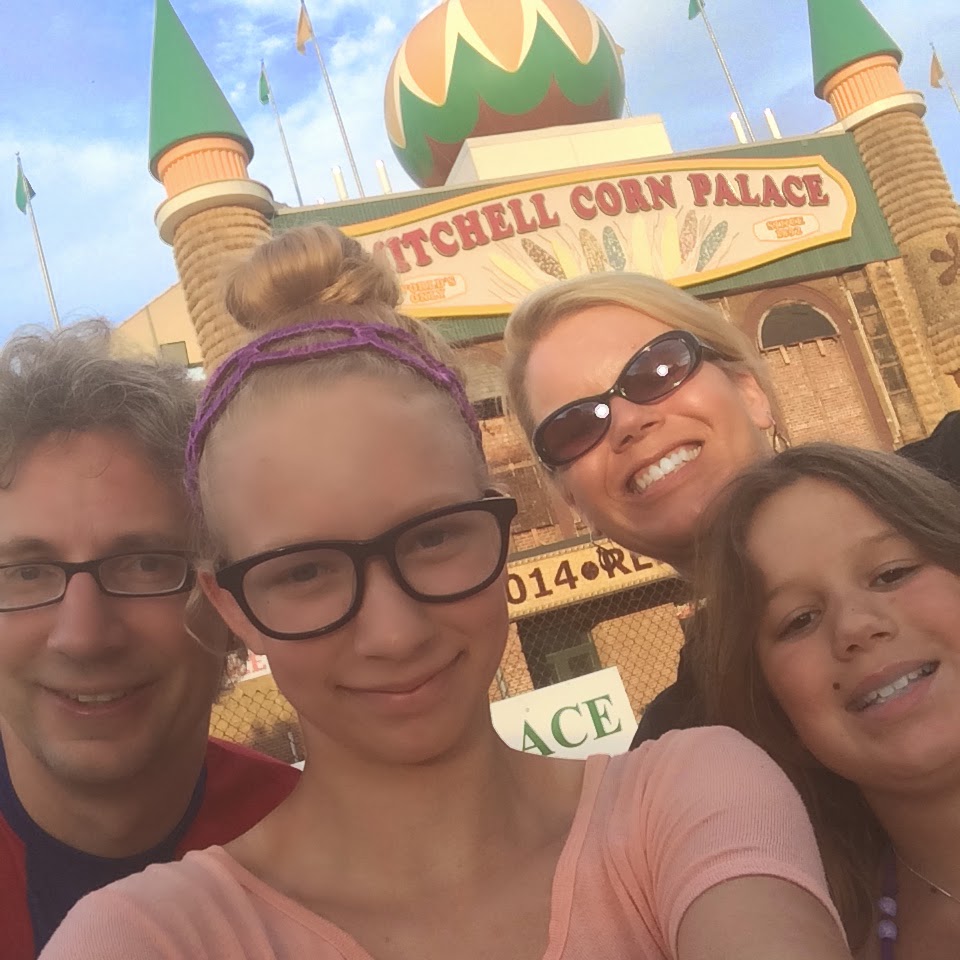
Although not nearly as famous as Alexander Mitchell and his Marine Bank, the town also boasts the World's Only Corn Palace. The original corn palace, built in 1892, was used to encourage people to settle in the area by claiming South Dakota had rich soil. However, by 1933, angry farmers attempted to burn down the palace after all of the "rich" soil had blown away in the Dust Bowl. 

Moorish (or for fans of Trivial Pursuit and Sienfeld, Moopish) minarets were added in 1937 and used as watch towers against any angry farmers that approached the palace. By 2004, the Department of Homeland Security was spending money to protect the Corn Palace against any terrorist farmers. Today, the Corn Palace is a sedate icon of South Dakota that is used for high school basketball games and senior proms. 

With such a storied and tumultuous history, a stop at the Corn Palace was a must on our westward trip.


A corny #selfie


Guard booth constructed with funds from the Department of Homeland Security


Tractor used by angry farmers in their assault upon the Corn Palace in 1933


Camouflage used in 2004 by the Department of Homeland Security to protect the Corn Palace from terrorist farmers 

After our visit to the World's Only Corn Palace (which is a good thing . . .), we ate dinner at Corona Village, which is Mitchell's second finest restaurant according to Tripadvisor. The food was bland and insipid. Perhaps this says something about culinary tastes on Great Plains.

After dinner, we drove for another hour arriving at about 10:45 pm at our final destination of the evening, the Super 8 in Chamberlain. Sitting where the Missouri River crosses I-90, Chamberlain is billed as Where the West Begins by Al's Oasis, a local establishment. Unfortunately, the Super 8 did not live up to this majestic slogan.

Although the woman who checked us in was chatty, explaining that she had just moved up from Kansas, worked another job at the hospital, and had never been to Mount Rushmore, but was going to see in this fall - she later told us that we should not walk around our room because the person below us was complaining we were loud. Apparently, the floor at the Super 8 is Super Thin.

And so ended our first day of our westward adventure.

Monday, June 2, 2014

Black Friday 2013 - One Thousand Years of Civilization and Literature

November 29, 2013

Black Friday - the height of consumer madness. As an alternative in 2011, I took Thane and Nastassja to Springfield, Illinois to see the sites of that hallowed American saint, Abraham Lincoln. In 2013, we spent Black Friday touring the greatest prehistoric city in the United States and one of the oldest European settlements in the Midwest: Cahokia Mounds and St. Louis - which are located within eight miles of each other.

We left Madison around 7 o'clock in the am as the sun was just starting to rise with temperatures in the teens. The drive south from Madison across the flat lands of central Illinois is one of the most boring routes in America. Flat farmland that is only broken up by a few giant wind farms north of Bloomington-Normal. After five hours of this bleak landscape we arrived at Cahokia Mounds State Historic Site.

One of only 21 UNESCO World Heritage Sites in the United States, Cahokia Mounds was the largest settlement in the Native American Mississippian culture, reaching a population as large as 40,000 people by the 12th Century. More importantly, Cahokia was the center of pre-Columbian Mounds candy bars production.

By the time Europeans had arrived, the site had been abandoned for unknown reasons. Proposed theories for this abandonment include over-hunting and deforestation. However, most modern scholars now believe that the domestication of the almond led to the Mounds downfall as the Almond Joy candy bar was both tastier and more nutritious.

On arrival, we toured a very nice visitor center which contained an informative and well-done exhibit on Mississippian culture. It also contained the famous Birdman tablet which, contrary to popular belief, is not an image of Robert Stroud, otherwise known as the Birdman of Alcatraz.

After leaving the visitor center, we walked over to Monk's Mound, the largest of the many mounds on the site. Named after the French Trappist Monks who grew food on the mound and attempted to revised the Mounds candy bar production in the early 19th Century, the mound is 100 feet high and was constructed over 1,000 years ago by the Mississippian culture.


Nastassja was as happy as a monk to be climbing the mound on this fine fall day.


Original steps built by the monks so they could quickly access their famous Trappist beers, which they stored at the top of the mound.

Once we reached the top of Monk's Mound, the views were incomperable as you could see the city named after King Louis IX of France in the distance, along with the Gateway Arch. Unknown to most, the Gateway Arch was the fulfillment of Louis IX dream to build an arch so high that it appeared to reach the heavens. 

Originally, Louis IX had planned to set out for the city on the Mississippi named after him in 1271 in his famous "Golden Arches Crusade" in order to construct the Gateway Arch. Alas, the famous king died during the Eight Crusade in August of 1270. Various causes of his death have been put forth, including typhoid and bubonic plague. However, modern scholars now believe Louis IX was poisoned by the Burger King, ruler of England at the time, who was afraid that Louis's Gateway Arch would be used as a symbol of a rival fast-food empire.


High atop Monk's Mound, the Gateway Arch, the culmination of Louis IX's lifelong dream, can be seen eight miles away.

After climbing Monk's Mound, we took a short drive to the nearest gas station so I could buy a Mounds Bar to consume outside the other famous site in Cahokia, Woodhenge. This timber circle is similar to England's Stonehenge and may have been used as a giant solar calendar. Whatever its use, the producers of This is Spinal Tap originally wanted to use Woodhenge in their famous megalith scene but were unable to to secure the rights to use the timber circle and had to settle on Stonehenge.


The kids excitement at seeing Woodhenge was so intense as to be palpable.

Finished with our visit of Cahokia Mounds, we headed up the road a little ways to the Lewis & Clark State Historic Site located at the confluence of the Missouri and Mississippi Rivers. The site was located near Camp River Dubois (the original camp is now in the middle of the Mississippi due to changes in the river's course), where Huey Lewis and Clark W. Griswold camped during the winter of 1803 and 1804 before setting out on their famous voyage to the Pacific Ocean.

The historic site had a nice little visitor's center, which included a tour of the replica fort that Huey Lewis and Clark Griswold sheltered in, a facsimile of the boat the pair took up the Missouri, and a little old lady at the visitor center desk who told Nastassja that she had a service for taking care of obnoxious brothers.


A replica of the boat that Huey Lewis first performed "Back in Time" while heading up the Missouri River in 1804.

During the short tour of the fort, in which we were the only people under the age of 80, our guide enlightened us on the meaning of "rolling in the hay" and informed Nastassja that back in the days of Lewis & Clark, girls were married off at the age of 14. In addition, one of the elderly women on our tour (who probably remembered when girls were married off at 14) inquired about borrowing one of the replica canoes on the site so she could take her friend all the way to New Orleans. Oh that octogenarian humor!


There you have it - the confluence of the two greatest North American rivers.

In keeping in the spirit of Clark W. Griswold, we continued our whirlwind tour and headed straight to the Gateway Arch. The world's tallest arch was constructed as a monument to the westward expansion of the United States in the 19th Century. However, the inside of the monument, including the "space-age" elevator feels much more like the 1960s Star Trek vision of the future.


Believing that the arch was the entrance to a giant McDonalds, Thane and Nastassja are excited about the french fries they believe are just ahead. 

After a quick dinner of pizza at the nearby Angelo's Taverna, we took the Ferris Wheel like elevator to the top of the arch. Beautiful, but tiny views of downtown St. Louis and the Mississippi river greeted us.


Like the original Enterprise on Star Trek, the designers of the Arch left a spartan and tiny window to view the city below.